Feeling Fine Is Not a Health Plan: The Hidden Danger of Skipping Your Annual Screenings

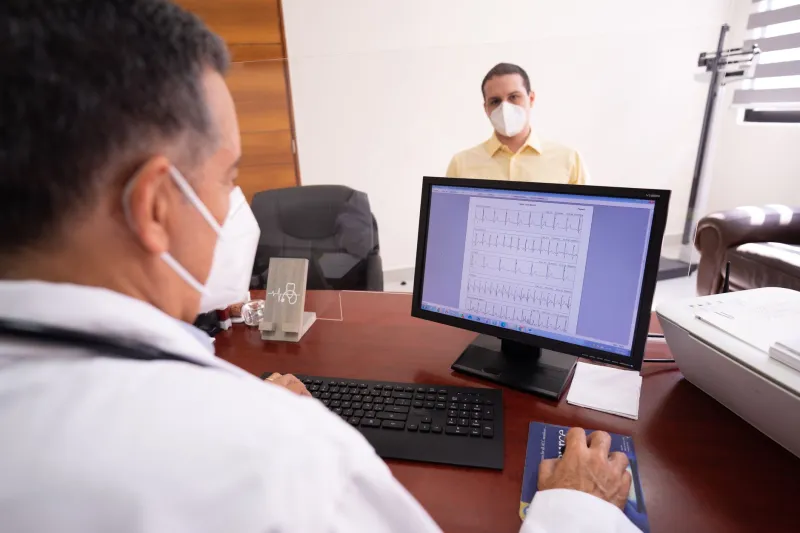
Photo: middle-aged man talking to male doctor during annual checkup in modern clinic, via c8.alamy.com
Let's be direct about something that the data makes unmistakably clear: American men are not going to the doctor, and it is killing them.
Not dramatically, not all at once — but incrementally, predictably, and often entirely preventably. The gap in life expectancy between men and women in the United States currently stands at approximately five years, and a significant portion of that gap is attributable not to biology, but to behavior. Specifically, the behavior of avoiding preventive care until a health crisis makes avoidance impossible.
The most common explanation men offer for skipping annual screenings is a variation of the same sentiment: I feel fine. It is a statement that sounds reasonable. It is also, from a clinical standpoint, profoundly unreliable as a measure of health.
The Psychology Behind 'I'll Go When Something's Wrong'
The decision to delay medical care is rarely a single, conscious choice. It is a pattern of reasoning that accumulates over time, reinforced by competing priorities, cultural expectations, and a fundamental misunderstanding of how disease actually works.
For many men, particularly those between the ages of 30 and 55, the healthcare system exists in the background of life — something to engage with when something goes wrong, not as a standing appointment on the calendar. Work schedules, family obligations, and the general friction of navigating insurance and appointment booking all serve as convenient justifications for delay.
Beneath these logistical excuses, however, lies something more psychological: a deep-seated reluctance to confront the possibility that something might be wrong. Going to the doctor when you feel healthy requires acknowledging that health is not guaranteed — and for many men, that acknowledgment feels uncomfortable in a way that is easier to avoid than to address.
This is not weakness. It is a well-documented human tendency. But it is one with measurable consequences.
What Three Years of Missed Screenings Actually Means
Consider the typical trajectory. A man in his early 40s last had a physical three years ago. He feels reasonably well. His energy is adequate, he has no significant pain, and his weight, while perhaps higher than ideal, has not changed dramatically. From the outside — and from the inside — nothing seems urgent.
Now consider what three years means in clinical terms for conditions that progress without symptoms.
Hypertension can develop and escalate significantly within a three-year window. A blood pressure reading that was borderline high at his last visit may now be in a range that is actively damaging his cardiovascular system. He will not feel this. Type 2 diabetes, if he was in a prediabetic state three years ago, may have progressed to a diagnosed condition — one that, had it been caught early, might have been reversed through dietary changes alone. Early-stage colorectal abnormalities that were small and manageable polyps in their earliest form may now require more aggressive intervention.
Three years is not a short interval in the biology of disease progression. It is a meaningful window during which conditions that are highly treatable at one stage can advance to stages where they are not.
The Statistical Case for Showing Up
The evidence in favor of preventive screening is not subtle. Colorectal cancer, when detected at its earliest localized stage, has a five-year survival rate of approximately 91 percent. When detected after it has spread to distant organs, that rate drops to roughly 13 percent. The difference between those two outcomes is frequently a matter of whether a person kept a scheduled appointment.
For cardiovascular disease — the leading cause of death among American men — routine blood pressure and cholesterol screening allows for interventions that meaningfully reduce the risk of heart attack and stroke. These are not marginal improvements. They are the difference between a managed condition and a medical emergency.
The math is not complicated. The barrier is not informational. The barrier is behavioral.
Dismantling the Excuses One by One
"I don't have time." Preventive screenings, including blood panels, blood pressure checks, and basic physical exams, can often be completed within an hour. The time required to manage a serious, late-stage illness — including hospitalizations, specialist appointments, and recovery — is measured in weeks and months. The trade-off is not balanced.
"I can't afford it." Many preventive screenings are covered in full under the Affordable Care Act for individuals with qualifying insurance plans, meaning there is no out-of-pocket cost for the patient. SmartMedic Testing provides clear information on what is covered and what to expect financially before you book.
"I'll go when something actually bothers me." This is the most dangerous misconception of all. The conditions most likely to be fatal — heart disease, certain cancers, hypertension, diabetes — are precisely the ones that do not bother you until they have already progressed. Waiting for a symptom is, in many cases, waiting too long.
"I went a few years ago and everything was fine." A clean bill of health from three years ago is a snapshot, not a guarantee. Health is not static. Annual and biennial screenings exist because the body changes, and conditions develop over time.
Making Preventive Care a Non-Negotiable Habit
Habit formation research is consistent on one point: behaviors that are frictionless are far more likely to be maintained than those that require significant effort. The practical implication for preventive care is that reducing the logistical burden of scheduling and attending screenings is directly linked to whether men actually do it.
This is a core reason SmartMedic Testing exists. Our platform is built to remove the friction from the process — providing clear guidance on which screenings are recommended based on age and risk profile, enabling straightforward appointment booking, and offering transparent information about what each test involves and why it matters.
Beyond logistics, consider building your annual screening into a routine that already exists. Schedule it the same week every year — around a birthday, a tax deadline, or any other annual marker that already carries behavioral momentum. Tell someone else you've scheduled it. Accountability, even informal accountability, meaningfully increases follow-through.
The Standard Worth Setting
There is a version of masculinity in American culture that equates stoicism with strength — that frames going to the doctor as an admission of vulnerability rather than an act of responsibility. That framing is outdated, and it is measurably harmful.
Knowing your health status is not weakness. It is precision. It is the same instinct that leads a person to check their car's oil before a long drive rather than waiting for the engine to fail on the highway. Preventive care is applied intelligence — the recognition that small investments in monitoring yield significant returns in outcomes.
If your last screening was three years ago, that is not a reason for shame. It is a reason to schedule one today. SmartMedic Testing is here to make that as straightforward as possible.
Know your health. Act early. Live better.